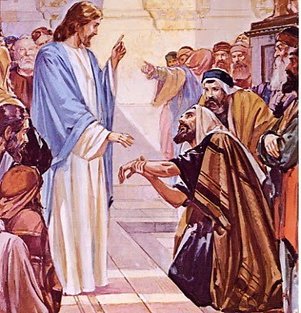
 Picking Grain on the Sabbath 1 At that time Jesus was going through a field of grain on the sabbath. His disciples were hungry and began to pick the heads of grain and eat them. 2 When the Pharisees saw this, they said to him, “See, your disciples are doing what is unlawful to do on the sabbath.” 3 He said to them, “Have you not read what David did when he and his companions were hungry, 4 how he went into the house of God and ate the bread of offering, which neither he nor his companions but only the priests could lawfully eat? 5 Or have you not read in the law that on the sabbath the priests serving in the temple violate the sabbath and are innocent? 6 I say to you, something greater than the temple is here. 7 If you knew what this meant, ‘I desire mercy, not sacrifice,’ you would not have condemned these innocent men. 8 For the Son of Man is Lord of the sabbath.” The Man with a Withered Hand 9 Moving on from there, he went into their synagogue. 10 And behold, there was a man there who had a withered hand. They questioned him, “Is it lawful to cure on the sabbath?” so that they might accuse him. 11 He said to them, “Which one of you who has a sheep that falls into a pit on the sabbath will not take hold of it and lift it out? 12 How much more valuable a person is than a sheep. So it is lawful to do good on the sabbath.” 13 Then he said to the man, “Stretch out your hand.” He stretched it out, and it was restored as sound as the other. 14 But the Pharisees went out and took counsel against him to put him to death. The Chosen Servant 15 When Jesus realized this, he withdrew from that place. Many [people] followed him, and he cured them all, 16 but he warned them not to make him known. 17 This was to fulfill what had been spoken through Isaiah the prophet: 18 “Behold, my servant whom I have chosen, my beloved in whom I delight; I shall place my spirit upon him, and he will proclaim justice to the Gentiles. 19 He will not contend or cry out, nor will anyone hear his voice in the streets. 20 A bruised reed he will not break, a smoldering wick he will not quench, until he brings justice to victory. 21 And in his name the Gentiles will hope.” Jesus and Beelzebul 22 Then they brought to him a demoniac who was blind and mute. He cured the mute person so that he could speak and see. 23 All the crowd was astounded, and said, “Could this perhaps be the Son of David?” 24 But when the Pharisees heard this, they said, “This man drives out demons only by the power of Beelzebul, the prince of demons.” 25 But he knew what they were thinking and said to them, “Every kingdom divided against itself will be laid waste, and no town or house divided against itself will stand. 26 And if Satan drives out Satan, he is divided against himself; how, then, will his kingdom stand? 27 And if I drive out demons by Beelzebul, by whom do your own people drive them out? Therefore they will be your judges. 28 But if it is by the Spirit of God that I drive out demons, then the kingdom of God has come upon you. 29 How can anyone enter a strong man’s house and steal his property, unless he first ties up the strong man? Then he can plunder his house. 30 Whoever is not with me is against me, and whoever does not gather with me scatters. 31 Therefore, I say to you, every sin and blasphemy will be forgiven people, but blasphemy against the Spirit will not be forgiven. 32 And whoever speaks a word against the Son of Man will be forgiven; but whoever speaks against the holy Spirit will not be forgiven, either in this age or in the age to come. A Tree and Its Fruits 33 “Either declare the tree good and its fruit is good, or declare the tree rotten and its fruit is rotten, for a tree is known by its fruit. 34 You brood of vipers, how can you say good things when you are evil? For from the fullness of the heart the mouth speaks. 35 A good person brings forth good out of a store of goodness, but an evil person brings forth evil out of a store of evil. 36 I tell you, on the day of judgment people will render an account for every careless word they speak. 37 By your words you will be acquitted, and by your words you will be condemned.” The Demand for a Sign 38 Then some of the scribes and Pharisees said to him, “Teacher, we wish to see a sign from you.” 39 He said to them in reply, “An evil and unfaithful generation seeks a sign, but no sign will be given it except the sign of Jonah the prophet. 40 Just as Jonah was in the belly of the whale three days and three nights, so will the Son of Man be in the heart of the earth three days and three nights. 41 At the judgment, the men of Nineveh will arise with this generation and condemn it, because they repented at the preaching of Jonah; and there is something greater than Jonah here. 42 At the judgment the queen of the south will arise with this generation and condemn it, because she came from the ends of the earth to hear the wisdom of Solomon; and there is something greater than Solomon here. The Return of the Unclean Spirit 43 “When an unclean spirit goes out of a person it roams through arid regions searching for rest but finds none. 44 Then it says, ‘I will return to my home from which I came.’ But upon returning, it finds it empty, swept clean, and put in order. 45 Then it goes and brings back with itself seven other spirits more evil than itself, and they move in and dwell there; and the last condition of that person is worse than the first. Thus it will be with this evil generation.” The True Family of Jesus 46 While he was still speaking to the crowds, his mother and his brothers appeared outside, wishing to speak with him. 47 [Someone told him, “Your mother and your brothers are standing outside, asking to speak with you.”] 48 But he said in reply to the one who told him, “Who is my mother? Who are my brothers?” 49 And stretching out his hand toward his disciples, he said, “Here are my mother and my brothers. 50 For whoever does the will of my heavenly Father is my brother, and sister, and mother.”
0 Comments
Whew! I have to admit that constantly doing in-depth Bible study is hard work. And while I will continue to do it (after all, I love it!), an occasional break for humor can benefit us all. I've made a few dinners like this.... [For those of you who don't know, my "real" life is being "The Housewife Modern" while this website and study and are for faith and growth reasons.] 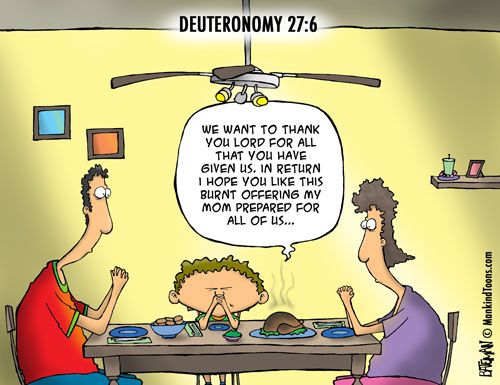 And anyone who has had a cat understands completely: 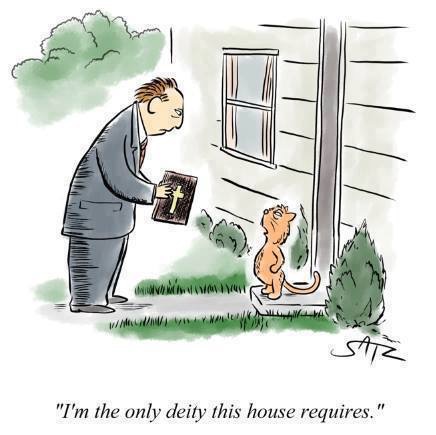 Thank you to my friend Neth for finding the cat one! 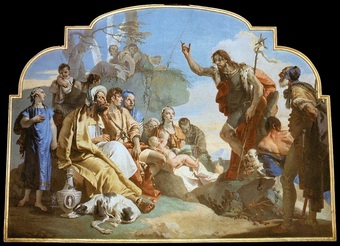 "11:2-6 These verses contain a school of debate, probably of post-resurrection origin, over the nature of Jesus' mission, held between disciples of JBap and Christians (Brown et al., p. 652). 11:2 'the works of the Messiah'/ striking phrase created by Matthew turns the debate into one of Messiahship, while it originally might have been one of whether or not he was a divine prophet. 11:3 "John the Baptist had already, on several occasions, declared that Jesus was the Messias. (John i). He could not then doubt of it himself, but sent his disciples to take away their doubt. (Witham)" (Haydock, MT 11:3). 11:5-6 Jesus' response fulfills (and is taken from) the passages of Isaiah. 11:7-19 While Jesus rebukes John, he also reminds all of the greatness of John the Baptist's function. 11:9-10 Common Jewish belief held that there had been no prophet since Malachi, but the coming of a new prophet was eagerly awaited. Because Mal 3:1 & Ex 23:20 both indicate that this prophet was the messenger who would proceed the one who would bring the final age. 11:12 'violent ones take it by a force'/ a puzzling saying over which meaning is disputed. Oddly enough, if you read it with modern eyes, it sounds as if Jesus is talking to us. 11:13 Matthew inverts the normal order and says "prophets and the law" emphasizing the important of the prophetic passages of the law (and "its fulfillment in the teaching of Jesus and to the transitory nature of some of its commandments" (Catholic Book Publishing). 11:14-15 While there were multiple (confusing) notations on these verses, this is the one I found most understandable: "John is here styled Elias, not in the same manner as those who taught the transmigration of souls; but the meaning is, that the precursor came in the spirit and virtue of Elias, and had the same fulness of the Holy Ghost...(St. Jerome in St. Thomas Aquinas)" Haydock, 11:14. 11:16-19 Difficult parable with much dispute about its meaning. 11:19 'Wisdom is vindicated by her works' is sometimes translated as 'Wisdom is justified by her children' 11:21 Tyre, Sidon: pagan cities denounced for wickedness in OT. 11:25-26 This same sentiment (words similar, probably drawn from Q) is also expressed in Lk 10:21-22. 11:27 This verse is vital and is expressed in Lk also. If authentic, as it may well be, it would give us a most important clue to Jesus' self-understanding as absolute Son of the absolute Father (Brown et al., p.653). 11:28-29 These verses are only in Matthew in NT, and are similar to Sirach 51:23-26. 11:29 Jesus clearly states to take the yoke of following his word instead of the yoke of the law. 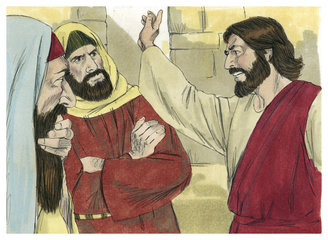 1 When Jesus finished giving these commands to his twelve disciples, he went away from that place to teach and to preach in their towns. The Messengers from John the Baptist 2 When John heard in prison of the works of the Messiah, he sent his disciples to him 3 with this question, “Are you the one who is to come, or should we look for another?” 4 Jesus said to them in reply, “Go and tell John what you hear and see: 5 the blind regain their sight, the lame walk, lepers are cleansed, the deaf hear, the dead are raised, and the poor have the good news proclaimed to them. 6 And blessed is the one who takes no offense at me.” Jesus’ Testimony to John 7 As they were going off, Jesus began to speak to the crowds about John, “What did you go out to the desert to see? A reed swayed by the wind? 8 Then what did you go out to see? Someone dressed in fine clothing? Those who wear fine clothing are in royal palaces. 9 Then why did you go out? To see a prophet? Yes, I tell you, and more than a prophet. 10 This is the one about whom it is written: ‘Behold, I am sending my messenger ahead of you; he will prepare your way before you.’ 11 Amen, I say to you, among those born of women there has been none greater than John the Baptist; yet the least in the kingdom of heaven is greater than he. 12 From the days of John the Baptist until now, the kingdom of heaven suffers violence, and the violent are taking it by force. 13 All the prophets and the law prophesied up to the time of John. 14 And if you are willing to accept it, he is Elijah, the one who is to come. 15 Whoever has ears ought to hear. 16 “To what shall I compare this generation? It is like children who sit in marketplaces and call to one another, 17 ‘We played the flute for you, but you did not dance, we sang a dirge but you did not mourn.’ 18 For John came neither eating nor drinking, and they said, ‘He is possessed by a demon.’ 19 The Son of Man came eating and drinking and they said, ‘Look, he is a glutton and a drunkard, a friend of tax collectors and sinners.’ But wisdom is vindicated by her works.” Reproaches to Unrepentant Towns 20 Then he began to reproach the towns where most of his mighty deeds had been done, since they had not repented. 21 “Woe to you, Chorazin! Woe to you, Bethsaida! For if the mighty deeds done in your midst had been done in Tyre and Sidon, they would long ago have repented in sackcloth and ashes. 22 But I tell you, it will be more tolerable for Tyre and Sidon on the day of judgment than for you. 23 And as for you, Capernaum: ‘Will you be exalted to heaven?l You will go down to the netherworld.’ For if the mighty deeds done in your midst had been done in Sodom, it would have remained until this day. 24 But I tell you, it will be more tolerable for the land of Sodom on the day of judgment than for you.” The Praise of the Father 25 At that time Jesus said in reply, “I give praise to you, Father, Lord of heaven and earth, for although you have hidden these things from the wise and the learned you have revealed them to the childlike. 26 Yes, Father, such has been your gracious will. 27 All things have been handed over to me by my Father. No one knows the Son except the Father, and no one knows the Father except the Son and anyone to whom the Son wishes to reveal him. The Gentle Mastery of Christ 28 “Come to me, all you who labor and are burdened, and I will give you rest. 29 Take my yoke upon you and learn from me, for I am meek and humble of heart; and you will find rest for your selves. 30 For my yoke is easy, and my burden light.” 
God says to you: "Do not be afraid of holiness; do not be afraid to aim high, to let yourself be loved and purified by God; do not be afraid to let yourself be guided by the Holy Spirit."
-Pope Francis, general audience, Oct. 2, 2013 I was scared. When I was seven and scared of everyone (I was shy). When I was a teen and didn't know who I was. When I was first with my husband and didn't know where life was going. Every time we move (we're military). It's a chance to start over. It's also closing your eyes, falling back, and hoping someone catches you. New house, new town, different state, no local friends, no family, and the million things that need done. Optimistic phrases and smiles only cover the fear. Looking back- and I'm still fairly young- I see a pattern. When I took a deep breath and actually let it go...let myself fall back into complete darkness...when I stopped trying to do it myself.......I never fell. The rough times were necessary to make me the person I am today. I know there will be struggles in the future- I think a well-lived life will be filled with adversity. Today I pray: I always, each and every single day, remember to take that deep breath, cross my arms, close my eyes, and fall back. Take the chance and trust God; open myself to receive the guidance He wants to give me. "I only see my goals, I don't believe in failure. 'Cause I know the smallest voices. They can make it major." - Lukas Graham
I suggest turning up the volume. Very powerful.
I've been feeling that tug again...that tug to write, study, etc. But I want to make sure it is the right thing to jump back into this. So, please pray for me. Specifically for God to guide me to know whether working on this site (along with my "real" one) is what I should be doing. I feel very selfish asking for people to pray for me, which is probably actually a form of pride. And also, as always, spare a prayer for my nephew Drew (2 years old, stage 4) & his family.  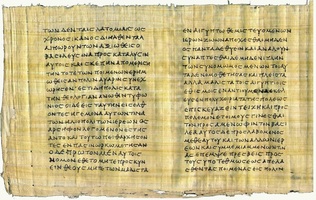 The most important LXX manuscripts (because of their stage of preservation, text quality, and relative age) are the following codices (books), commonly referred to as the Great Uncials. The term "uncial" indicates that they were written using capital letters only, for the Greek alphabet used no small ("miniscule") letters until several centuries later. Following are the contents of the Great Uncials: • Codex Sinaiticus (4th century), labeled Aleph: Genesis...Numbers...Joshua (part); Judges...1-2 Chronicles; 1 Esdras; Ezra-Nehemiah; Tobit; Judith; 1 & 4 Maccabees; Isaiah; Jeremiah; Lamentations; the Twelve (incomplete); Psalms; Proverbs; Ecclesiastes; Song of Songs; Wisdom of Solomon; Sirach; Job. Certain books are missing/lost. Psalms contains Psalm 151 as part of the regular Psalter. • Codex Vaticanus (4th century), labeled B: Genesis - Deuteronomy; Joshua son of Nun; Judges; Ruth; 1-4 Kingdoms; 1-2 Chronicles; 1 Esdras; Ezra-Nehemiah; Psalms - Sirach; Esther; Judith; Tobit; the Twelve; Isaiah; Jeremiah; Baruch; Lamentations; Letter of Jeremiah; Ezekiel; Daniel • Codex Alexandrinus (5th century), labeled A: Genesis - 2 Chronicles; the Twelve; Isaiah - Daniel; Esther; Tobit; Judith; 1 Esdras; Ezra-Nehemiah; 1-4 Maccabees; Psalms; Job; Proverbs; Ecclesiastes; Song of Songs; Widsom of Solomon; Sirach Psalm 151 is included as "outside the number." the Psalms of Solomon is listed in the table of contents for the codex but is not found in the codex itself. I'm also adding a great quote about the Septuagint from: "Exploring the Origins of the Bible (Acadia Studies in Bible and Theology): Canon Formation in Historical, Literary, and Theological Perspective" by Craig A. Evans & Emanuel Tov. This quote sums up what is so misunderstood. "Most scholars do not actually believe that there was a book (codex) form of the Septuagint at the turn of the millennia, but they still talk about “the Septuagint,” as if Paul, for example, had gone to the local Alexandrian Bible Society bookstore in Tarsus and purchased his own bound copy of The Septuagint, from which he preached." (Evan & Tov, p.192).  10:1 The disciples are given leave to drive out unclean spirits and the treat every illness, but they are not yet commissioned to teach. This will only come after Jesus' Resurrection. 10:2-4 This is the only time in Matthew that the Twelve are designated as 'apostles.' Apostle means "one who is sent." Prior to this, they were disciples. And later others will be sent as disciples. But these 12 are apostles, with special designation from Jesus. 10:2 'James, the son of Zebedee,' called James the greater, was put to death by Herod. He was brother to John the Evangelist. The other James was called the less, also James of Alpheus, and the brother of the Lord, bishop of Jerusalem, martyred there about the year 61. (Haydock) 10:3 Thaddaeus is mentioned only twice in Scripture, here and in Mk 3:18, both lists of the apostles. In the other two lists of the apostles (Lk 6:16 and Ac 1:13), only 11 are listed. (Gordon-Conwell). 10:4 'Simon the Cananean': Cananean means "zealot" but the meaning of the designation is unclear. Could simply reference his religious zeal -or- his official membership in the party of the Zealots. 10:5 See Bible study for this section on more explanation of why Jesus' instructions here excluded preaching to the Gentiles. 10:14 'Shake the dust from your feet': this gesture indications a complete disassociation from such unbelievers. The early church took the instructions given directly by Jesus here (and in Mark 6:6b-13) as a checklist/rules for missionaries and how to act with "those whose hospitality they sought" (Brown et al., p.609). 10:17 Jesus begins to speak of the persecutions that the apostles will undergo following his death & resurrection. 10:20 "the spirit of your father: In contrast to the Lucan parallel, Matt stresses that the holy Spirit is the spirit of God the Father" (Brown et al., p.651). 10:22 When Matthew refers to "the end" here, he is most likely referring to the end of that particular individual's life rather than the End of Times. 10:23 It is difficult to decipher how the disciples took the term "before the Son of Man comes." Obviously at this point the death and resurrection had not taken place. 10:25 'Beelzebul' means "prince of demons." As in the last chapter, this is a foreshadowing the charges that will be brought against Jesus. 10:34 'the sword' refers not an "uprising but as a regrettable side effect of tension and division resulting from the uncompromising proclamation of the kingdom" (Brown et al., p.652). 10:38 The first mention of the cross in Matthew, explicitly that of the disciple, but implicitly that of Jesus (and follow after me). During this time period, crucifixion was a form of capital punishment used by the Romans for offenders who were not Roman citizens (Catholic Book Publishing, fn). 10:39 One who denies Jesus in order to save one's earthly life will be condemned to everlasting destruction; loss of eathly life for Jesus' sake will be rewarded by everlasting life in the kingdom. 10:40-42 Those who receive the disciples of Jesus also receive Jesus. Forgive my absence. Life has been hectic, mostly with volunteer work. And while I love studying, I am a firm believer one should act for humanity when they can. I've also been trying to promote my other website. I will be resuming posting, but I must be honest: it will not be on the most frequent basis. Thank you to my continued readers, and check back. New information WILL be provided! 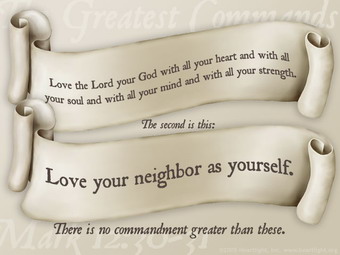 Before I write another word, I want to thank Jim Russell for his article in Catholic Answers (July-August 2014) magazine. I couldn't find a website for him (it appears he is more of a guest blogger rather than running his own website...but looking at all of his activities, I can understand this!), but the article stated that "some of his blog posts can be found at" http://blog.stlouisreview.com. You may have already noticed the "Prayer Before Writing" that is a constant on the blog sidebar. It has been a good reminder for me over the last few months to remember why I am writing (to learn more myself and hopefully to help bring others to Christ!). I would like to add what Mr. Russell calls a "communication covenant." To my readers & fellow writers, I promise: 1. I will pray that God's grace helps illuminate all of our interactions- both those of simple reading and more active conversations. 2. I will communicate with you respectfully and civilly. These are (rightly) issues which we feel passionate about. But even in disagreements, I will respect you fellow "seekers of truth." 3. I will not fall into negative behavior or words, such as insinuations, exaggerations, blames, or personal attacks. I respectfully ask you to do the same. 4. I will pray we will all find the truth and strive to fulfill the two greatest commandments: "You shall love the Lord your God with all your heart, with all your soul, with all your mind, and with all your strength.’ The second is this: ‘You shall love your neighbor as yourself.’ There is no other commandment greater than these." (Mark 12:30-31) |